
Thursday, April 24, 2008
Thoughts on Arnold Schwarzenegger

We're far removed from Arnold Schwarzenegger now. He's changed addresses, moved from the lobby poster to the political ad, from the movie theater to television news. Sure, a part of the old Schwarzenegger--the 1980s Schwarzenegger--remains on DVDs and the occasional midnight revival, but he's married to his politics now, and we can't separate the two (let alone divorce them) in our memories.
The last twenty years have infected the image of Schwarzenegger in the same way they've infected the songs of Michael Jackson. Schwarzenegger and Jackson stood out on the cultural landscape of the 1980s, so effortlessly alien. No one moved or talked quite like them. There had never been pop stars or film stars so devoid of pathos or motivation. Schwarzenegger would turn as though there were hydraulics hidden beneath his muscles; when you saw a photograph of him or Jackson, it seemed as though their bodies had been custom-built for the frame.
Schwarzenegger was not dispassionate; he simply made passion irrelevant. He approached every line of dialogue--the sarcastic quips provided by the screenwriters--with an astounding indifference. He was never human, never a feeling--he was always a sound and an image, and we never wondered what secret feelings might motivate him, but instead imagined ourselves as machines. Why have love when we could have love scenes? Why have hate when we could have a punch, a pistol shot, a well-worded put down? He made dispassion into a force, transforming inertness into inertia. He replaced acting with actions. Van Damme had an ace's cockiness, Stallone had Jerry Lewis's earnestness, Bronson had weathered distance, but Schwarzenegger would emit vaudeville puns like radio signals, as though he had a transmitter in place of vocal chords. His mouth was a slit in his face. He showed you that there was nothing human about the human body. You take the context away from a hand, a pair of shoulders, a head and it's no different from a chair, a window, a wall.
Watching his films forces me to question myself. History has a funny way of turning our interests against us. The 2003 California gubernatorial recall is an ugly but inseparable footnote to Commando and Red Heat. "Am I playing into the hands of Schwarzenegger the politician?" I think. The "man of action," the "thing that needs to be done" that exists outside of context or emotions, is the fallacy that serves as the basis of reactionary politics. The dream of the action film lead to the reality of a conservative America.
Did the dream fail? Or was it always waiting to betray us? I have a doubt, like a cough in the back of my throat: is fascination a surrender? Is interest an approval?

Monday, January 28, 2008
2007 in Review: The 21st Century / Uncle To / Free Women
 Frame from Flight of the Red Balloon (2007)
Hou Hsiao-Hsien, a filmmaker from the 20th century, has become, like David Lynch, a filmmaker of the 21st century at a time when so many 21st century filmmakers still make 20th century films with 20th century ideas. He's 60, but old people are always putting the young to shame. It's what they do best.
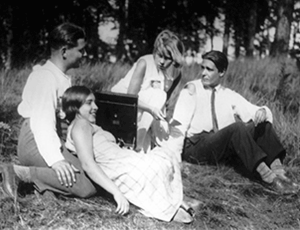
In Flight of the Red Balloon, he floats around 2007 with his camera and his microphone and turns the concrete into the vague and the vague into the concrete. Like People on Sunday, it's a memoir of the present: proof that cinema is greater than poetry. It is only as nostalgic for Albert Lamorisse's film as the present is for the past; an impossible gulf separate the two, and yet the latter is always inescapable, present in the form of places, memories, connotations. In the 21st century, we are always reminded that there has been so much history as now.
In Flight of the Red Balloon, he floats around 2007 with his camera and his microphone and turns the concrete into the vague and the vague into the concrete. Like People on Sunday, it's a memoir of the present: proof that cinema is greater than poetry. It is only as nostalgic for Albert Lamorisse's film as the present is for the past; an impossible gulf separate the two, and yet the latter is always inescapable, present in the form of places, memories, connotations. In the 21st century, we are always reminded that there has been so much history as now.
 The main characters pose for a picture in Exiled (2006; released in the States in 2007)
Fred Camper is braver than most of us. He dared to write about Johnnie To in terms we secretly wanted to use. In the language we wanted to apply: not in misleading Peckinpah and Leone comparisons, but in sacred words reserved for Grandpas Ford and Hawks, for classical cinema.
Exiled is the marriage of To, the pulp dramatist and comedian, and To, the poet of gangs and personal histories. Sympathetic critics compare the film to a late western, but only because westerns and film noir are the only genres to no longer carry a stigma--they've become sacred cannon. Others meekly say the movies is "more than an action flick," as if a work in that genre is incapable of greatness by default--to be good, it has to be similar to something else.
Exiled is certainly an action film, nothing more, and that is more than enough. It's a gun operetta, with choice solos by Anthony Wong's austerely jowled face, one of the most beautiful in modern cinema.
An actioner is as much about shootouts as a western is about horses and Indians or a film noir is about criminals. Most reviewers need new glasses; they mistake a ricocheting bullet for nihilism. Do they still mix up musical numbers with escapism?
 A promotional still for Death Proof (2007)
Why is Jackie Brown Quentin Tarantino's most lasting film? Because it's his least ironic. It's the work of a lover, not an expert. Of a friend, not a taxonomist. Most importantly, it's a movie by someone who believes in the exploitation film, not someone trying to sell their knowledge of the genre. Coincidentally, it's one of his least popular and commercially successful projects.
The extended cut of Death Proof, shown abroad and available on DVD in the US, will last, too. It treats the world of genre movies and general business of commercial filmmaking unironically. It emulates rather than imitates. It has a secret ambition: to move beyond Kill Bill's brand of Jack Hill "sexy feminism." Liberation through transgression: Tarantino's sexual fetishes are no longer suggested, but are instead lingered on; the abrupt, violent conclusion doesn't bring closure--it creates possibilities. Death Proof's free women are in the imagination of a free man.
Friday, January 25, 2008
2007 in Review: Two Subtle Leaps
Everyone has already written about their favorites. I've been lazy. I've spent January cleaning the salt off of my shoes; my fingers stink of vinegar. "What was your top ten for the year?" was a December question. It was asked on slow buses and in movie theater lobbies. Everyone agreed it'd been a "good year." Everyone wanted to know your favorites.
There's a difference between speaking and writing about movies. The problem with writing is that movies age differently from essays. Written words always feel like they're a million years old, already so far behind, but at the same time they don't get old quickly like films, which are so much like people--they get wrinkles, gray hair, they start to forget. What once seemed right becomes questionable. Movies are hard to judge, at least with traditional language. They shift in your memory and they tailor themselves to your experiences. What was a bad movie six months ago becomes a good one. The last year's masterpiece crumbles.
There's a difference between speaking and writing about movies. The problem with writing is that movies age differently from essays. Written words always feel like they're a million years old, already so far behind, but at the same time they don't get old quickly like films, which are so much like people--they get wrinkles, gray hair, they start to forget. What once seemed right becomes questionable. Movies are hard to judge, at least with traditional language. They shift in your memory and they tailor themselves to your experiences. What was a bad movie six months ago becomes a good one. The last year's masterpiece crumbles.
 Bill Morrison (left) and Ralph Tyler (right) in a still from Peoples House (2007)
I watched Andrew Bujalski's short Peoples House on the little TV set in my living room, sitting with the remote in my hand. Peoples House is only 8 minutes long. It lives in the extras of the DVD of Mutual Appreciation, Bujalski's second feature, just above the commentary and the trailer. It's Bujaski's first work in video, and his first in widescreen.
Aesthetically, Andrew Bujalski is Maurice Pialat's cousin. He is also Pialat's opposite. We see the same techniques in their films, but used for completely different reasons. Pialat's elliptical edits nonchalantly jump across time; he treats a few seconds or a few months the same way. The things that happened in between, the events we didn't see, have been omitted because they didn't matter. Certain events that we experienced seemed important at the time, but they aren't worth a damn in the long run. It can be heartbreaking.
Bujalski's ellipses instead give us an expansiveness. We cut from scene to scene because those are the moments we're focusing on for now, but the film acknowledges that a lot happened in between, or might have happened at the same time as the actions we're watching.
Peoples House is Bujalski's most elliptical film and his most quickly paced. We see moments from a lazy afternoon: Jerry Peoples (Ralph Tyler) shows Walter (filmmaker Bill Morrison) around his house. They talk about a grand piano, Walter takes a piss, Jerry shows him a sculpture in his back yard where hornets nest. It's set in the outside world Mutual Appreciation's gaps suggest: the subjects are supporting characters from that film. They are not the twentysomethings Bujalski's famous for: they're well-off middle-aged men; they talk about retirement, their children, work. Removed from the aesthetics , settings and subjects of Bujalski's other films, the film shows the expansiveness of his vision. It is a leap forward, and, appropriately enough, a subtle one.
 Lars von Trier during the production of The Boss of It All (2006; released in the States in 2007)
Lars von Trier is a liar. He's a traveling magician and a trickster. He distracts you this his left hand so you don't notice what his right hand is doing. He tells a cock-and-bull story while he's sliding your silverware into his jacket.
"The Boss of It All is a light movie," he says, and everyone nods along. We believe because it seems to make sense, like he's done all the detective work for us and, after all, he made it, so he must be right. It's a clever ruse: we don't notice that he's made the greatest leap of his career. He's the emperor who's fooled everyone into thinking he's got no clothes. The truth is that The Boss of It All is the first of von Trier's films to be moral instead of moralistic. Automavision is a fraud, but it's a fraud that's greater than the truth of Dogme.
"The Boss of It All is a light movie," he says, and everyone nods along. We believe because it seems to make sense, like he's done all the detective work for us and, after all, he made it, so he must be right. It's a clever ruse: we don't notice that he's made the greatest leap of his career. He's the emperor who's fooled everyone into thinking he's got no clothes. The truth is that The Boss of It All is the first of von Trier's films to be moral instead of moralistic. Automavision is a fraud, but it's a fraud that's greater than the truth of Dogme.
Tuesday, December 4, 2007
An Opuls Film / The High Sign

A key concept of the classic women's film is the Women's Secret; as manhood is a badge of honor, womanhood is a secret society, a terrifying mystery, a password, The High Sign. The women's films are full of invisible ink and substitution cyphers; to watch them is to be admitted to their secret world. There's more intrigue than in a hundred spy films. There are coded transmissions and cloak-and-dagger adventures, but no one ever get any medals. Men die gloriously in war films, while women have to suffer in melodramas. The women of women's films (and their audiences) recognize each other with passing glances. They know each other’s secret.
"You don't know how a family can surround you at times," says Joan Bennet to James Mason in The Reckless Moment, and of course he responds with a tense "No, I don't." How could he understand?
A little math: Max Ophüls made four pictures in the United States, one every year 1947-1949; only the first one isn’t a "women's picture"; on those three films, he signed his name Max Opuls, ditching not only the umlaut over his (adopted) surname but that pesky "h" too; and finally, while the first of those was a period piece, the last two were set in contemporary America, and of those The Reckless Moment is the second, making it Ophüls / Opuls’ last American picture.

It’s a blackmail plot: Bennet is the suburban mother with the steely resolve and Mason is the downtown mobster with the Irish brogue. He’s got letters incriminating her teenage daughter in a sleazy older lover’s death; he trails off while reading one aloud before the suggestive details become too strong. He’s in over his head; he’s the innocent. Being a criminal doesn’t prepare you for being a woman. He’s a naïf, taking the blame with his dying breath at the end of the film; he might absolve her of police action, but it’s nothing compared to her personal burden. The closest she can ever come to showing her emotions is by lying. In the final shot, with three men dead—Mason, his co-conspirator, the lover—she tells her husband about the Christmas tree they’re going to get. As she goes down the stairs to answer his telephone call, the camera explores every emotional possibility. She’s in turmoil, but no one notices. We’re in on her secret, and it’s terrifying.
Thursday, September 13, 2007
A Letter to Myself
Dear Ignatius,
The only things you've written lately are excuses. Get on top of it!
Sincerely,
You
The only things you've written lately are excuses. Get on top of it!
Sincerely,
You
Wednesday, August 22, 2007
Soviet Children's Cinema 1: A Childish Film
Over the course of the next few days, I'm hoping to watch as many Soviet children's films as possible.
 The shower sequence in a video still taken from a Kultura broadcast of The Foundling (1939)
Was The Foundling made by a child? Or maybe edited by one? The film is childish in the most beautiful sense of the word. It's like a grade schooler retelling a joke: details are stretched out, punchlines are mangled.
It's a reversal of the adult rules of comic order. A broken shower head commands our attention more than the mess it causes all over the bathroom walls or the people it worries; a traffic cop is shown repeatedly stopping a man from crossing the street in a rambling take. Scenes are played as if the previous ones have already been forgotten. It's small but ungainly, compact yet in over its head. Shot lengths, speeds and reaction shots seem out of scale. There are physical discrepancies within the frame, too: a short, pudgy woman argues with a lanky man; a tiny girl stands beside a balloon vendor with stilt-like legs; a long, narrow carpet runs treacherously through the hallway of a communal apartment (an early shot features a boy instinctively untangling it with his foot); a young soldier, whose gigantic hands and jutting chin bring together everything that can seem awkward about the human body, crouches wordlessly beside two young girls.
The children in the film speak too slow and too fast, repeat themselves and fidget. They tug at clothes, stand together uncomfortably in the frame and speak with an earnest seriousness amongst themselves. They act like children without consciously attempting to channel "childishness."
Barely over an hour long and ending with a lullaby, The Foundling can be found unsubtitled here.
Friday, August 17, 2007
Russian Notebook 2: Television Continued, Kultura
I'm currently in my father's home town, Rostov-on-the-Don, a hilly city built along the banks of a river in the South of Russia.
I watch television here on the Panasonic in the living room. It has a rabbit ear antenna. Usually I sit on the couch, which at night folds out into a bed. The apartment is on the fourth floor and the living room windows look out on one of the busiest intersections in the city. Across the street, there's an office whose windows are level with ours. I've recently noticed that a young woman who works in the office watches me when I play the living room piano. We keep the windows closed, so she can't tell that the piano is badly out of tune and that I can't play it very well.
In all, the television recieves 11 channels, though many of them are repeats. It recieves several I can't get in Moscow, including regional stations and MTV, whose modest local offices are a block up the street from our apartment.
The Panasonic does not get Kultura (Культура), which broadcasts Soviet films in the day time and symphonic concerts and foreign films in the evening (in the my first week, I saw an Oshima, a Moretti and a Jancso). The Soviet films are the real treasure--many of them pre-war, all of them in original aspect ratios, not just well-known pictures (next week brings The Mirror and Cranes Are Flying) but obscure and underrated ones as well. Musicals, lavish period films and war pictures are all shown without repeats and with minimal commercial interruptions. Silent films are not shown.
It's a challenge figuring out what the movies are at times without a steady Internet connection. There're plenty of television listings in the right-wing weeklies, but I'm little too embarassed to buy them or even be seen paging through one at a newstand. I keep a little red notebook into which I jot showtimes as they're advertised. I've turned into a serious television viewer, setting aside evening hours, looking forward to marathons, double-checking my daily Kultura itinerary.
I watch television here on the Panasonic in the living room. It has a rabbit ear antenna. Usually I sit on the couch, which at night folds out into a bed. The apartment is on the fourth floor and the living room windows look out on one of the busiest intersections in the city. Across the street, there's an office whose windows are level with ours. I've recently noticed that a young woman who works in the office watches me when I play the living room piano. We keep the windows closed, so she can't tell that the piano is badly out of tune and that I can't play it very well.
In all, the television recieves 11 channels, though many of them are repeats. It recieves several I can't get in Moscow, including regional stations and MTV, whose modest local offices are a block up the street from our apartment.
The Panasonic does not get Kultura (Культура), which broadcasts Soviet films in the day time and symphonic concerts and foreign films in the evening (in the my first week, I saw an Oshima, a Moretti and a Jancso). The Soviet films are the real treasure--many of them pre-war, all of them in original aspect ratios, not just well-known pictures (next week brings The Mirror and Cranes Are Flying) but obscure and underrated ones as well. Musicals, lavish period films and war pictures are all shown without repeats and with minimal commercial interruptions. Silent films are not shown.
It's a challenge figuring out what the movies are at times without a steady Internet connection. There're plenty of television listings in the right-wing weeklies, but I'm little too embarassed to buy them or even be seen paging through one at a newstand. I keep a little red notebook into which I jot showtimes as they're advertised. I've turned into a serious television viewer, setting aside evening hours, looking forward to marathons, double-checking my daily Kultura itinerary.
Russian Notebook 1: Crime Television
I'm living the month of August in Russia. One of my intentions was to try and document as much about Russian film culture as I could, but very early on I got sick and ended up bed-ridden for a while. During that time, I found myself watching a lot of Russian television.
- "Crime" shows dominate Russian television; they've been on top for quite a while, a decade maybe--enough for people to be long tired of them. But they're cheap to make and easy to advertise, so it's unlikely they'll leave airwaves anytime soon. In fact, their prevalence and interchangeability make them the defining genre of Russian television; it's often difficult to figure out which show you're watching--switching between channels seems more like intercutting than. The remote control becomes a method for home editing: from car chase to assassination to a busy street corner to car chase again without ever breaking continuity.
- "Crime" shows are both documentary and fiction-based (in Russian, fiction films are refered to as artistic films), though there's very little difference in content and presentation between the two. "True crime" shows often center around sensationalistic "investigative journalism" peppered with shots of real-life deaths, dramatic re-enactments and flashy graphics that resemble the credits and intertitles of the "fictional" crime shows (or is it the other way around?). The host of one show, which focues almost exclusively on bloody traffic accidents in Moscow, carries a small Handycam as a prop, pointing it at the proceedings; we never see what he's recording and can assume that the prop camera is never turned on.
- Despite being shot exlusively on video (shooting on film is very rare in Russia, where theatrical features are almost exclusively shot on HD), almost all fictional crime shows use post-synced dialogue. There is something fascinating about handheld, often rough images combined with calm, crisp sounds. On television, Moscow is the quietest city in the world, and the wind is never blowing in the country side. Foreign films and programs, which make up a sizeable portion of Russian television, are always shown dubbed, so this forms an odd aesthetic continuity.
Sunday, July 8, 2007
A Conversation with Usama Alshaibi About Nice Bombs
Usama Alshaibi smiles frequently. Luckily, he’s got a beautiful, toothy grin. The lower half of his face is covered by a black forest of stubble that’s too short to be called a beard but too thick to be called anything else.
Nice Bombs has had a longer gestation than a lot of your other work.
If it were any other season, we would call it a Friday evening—but it’s summer, so we say Friday afternoon (the Sun, after all, isn’t setting for a while). Alshaibi’s 2006 documentary Nice Bombs begins its first theatrical runs next week, and I’ve come by the apartment he shares with his wife and frequent collaborator, Kristie Alshaibi, to talk about the movie. I’m early, and one of the Alshaibis’ neighbors lets me up, asking whether I’m here for the party.
Nice Bombs has had a longer gestation than a lot of your other work.
Oh, yeah absolutely. I mean it’s my trying to branch out beyond dirty basements and underground fests. Nothing against dirty basements and underground fests, but always with this movie I was trying to appeal to a broader audience. I mean, I still make all sorts of films that I know are not gonna have any commercial success or theatrical distribution—but, eventually, they get in other festivals and on compilations. But with Nice Bombs there’s an immediacy I wanted. I wanted to get it out there and I wanted other people to help me out.
Maybe it doesn’t have a longer gestation, maybe there’s a kind of inverse relationship: some of [your short] films were made very quickly but it took them a very long time to…well, they’ll play at festivals for years. With Nice Bombs it took you a long time to make it—you started it in 2004, so it took two years and now it’s getting theatrical distribution a year later.
But, as you know, as film business goes, it’s not unusual in my time frame. It’s pretty normal. I mean, if I were a big production, it would take the same amount of time. What we spent so much time on was post-production. I was really able to do a lot and focus on things in a way I wasn’t able to before. I had access to real studios and engineers and a full ensemble of musicians who were writing music for specific scenes…and that was weird…what was the question?
Well, it was more of a statement. It seems like a lot of…well, for example, King for a Day seems to have come together very quickly.
Well, King for a Day, that musical I was doing kind of quietly until it was out there because I wasn’t sure it was gonna make it.
Going back to Nice Bombs—with Nice Bombs the first time we showed it in Chicago it was a much longer cut, and since then I’ve edited it down to 76 minutes, which, to me, has made it an even more powerful film.
Was this the one that was screened at the Music Box?
Yeah. So, from that period on, I got distribution and now it’s getting a theatrical release…I think also it is technically my first feature. To have this kind of success—for me, it’s great. Some other filmmakers will be like, “Whatever.” But for me, a ten day run at the Pioneer and a release at the Gene Siskel [Film Center] and hopefully more…well, I’ve never gotten that before. I think it’s a testament to the film and everyone who’s worked on it.
Even though I do use my story and myself, I’ve also made it very accessible. People who have always disliked my work, relatives who just don’t go near my stuff, it’s very appealing to them, and I like that. Even my wife’s relatives, who live in the Midwest. Regular folks. Americans from suburban neighborhoods. Republicans watch this and they really dig it, they’re really into it. They get attached to the characters—the people in the movie. So I think that’s something new that I’ve discovered about myself and what I’m capable of. If I just take these risks and put myself out there, and get away from these boundaries, these artificial boundaries that we set for ourselves when we make any form of art, you know?

Absolutely. And to me it’s also gotta be exciting. If it scares me, if I’m, like, nervous, if I’m like “I don’t know if I can do this,” that means the project is good. I’m on to something. If it’s like, “Oh, I know this, this is easy, this is already done in my head”—well, why go through the process? I guess I like discovering things.
The documentary element is not necessarily new, because I also approached my narrative work like that. Some of my early shorts had no script, just a very abstract idea. Or I’d be writing as I was shooting. But with this, it was even more abstract. I was able to kind of take all of that and put it into something coherent. But the experience and the film are almost two different things. Experience inspired me to take the camera and do all of this stuff, but my internalized experience and its connection to the film is something I have that makes things exciting and significant for me. So now I’m approaching everything like that. I don’t know what the hell I’m doing. Part of it and part of what I do is a mystery. It’s a dark tunnel I’m walking into and I only have a little light. Stuff might come out…[laughs] Open to the unexpected.
Do you feel like Nice Bombs was a continuation of your work or do think it’s more of an expansion? Because it doesn’t…to an outside observer it seems odd. To someone who has never met you and has only seen your movies, it seems like a strange direction to take.
Well, what was the longest film I did before that? Muhammad and Jane. All about a European-Iraqi character who comes back to the United States. He was just in Iraq and the United States in the movie is preparing to go to war. It’s this fictional aspect to real life, to something that was happening politically in the street. In fact, we shot part of the movie at an Iraq war protest, and, I think it was on my mind.
Ignatius, I always had this idea that I would go back to Iraq before I picked up a camera and started making films. It seemed like a natural progression. I don’t really think I have enough work out there on this scale to say I have any set way of doing things. I like to surprise myself. I don’t feel like I’m locked down in any sort of genre or form of filmmaking.
Well, maybe it’s best not to have a set way of doing things. Maybe it’s best just to approach everything as if you’ve never done it before.
It’s funny that you say that, because my next film, which is called Baghdad, Iowa, sort of takes what I love about documentaries and takes what I like about fiction filmmaking and blends it in this not really noticeable way. Because documentary is also a form of fiction-making. People don’t realize that. You’re still manipulating information to convey something.
Tell me about Baghdad, Iowa.
I started this a while ago, sort of quietly, because I don’t know what I’m doing sometimes until it’s forming. It was really a sort of organic process. It came out of wanting philosophically to explore more of Nice Bombs, but also realizing that I had to end this movie and couldn’t keep going on and expounding for hours. And so Nice Bombs was in a way looking back to the Middle East, to my past there and then returning—completing something. Baghdad, Iowa is my returning here. And I came from Baghdad, Iraq and landed in Iowa, which is the first place I lived in the United States. My father went to school in Iowa City, Iowa. So my impression of the world was very Americanized but also was Iraqi. And the movie is an exploration of that, in a very surreal way.
You said earlier—I think at the very beginning of the interview—that to you Nice Bombs was a film with a broader appeal, a movie that was meant to be shown more theatrically, rather than at small festivals.
I guess I wanted to make something accessible, I wanted to make something that didn’t have…I guess what I’ve saying is that, since my experience is so unique, I didn’t have a very good perspective on it. Because it was so much about my experience, I needed outside eyes. So I got producers and I worked with editors. I even had a test audience. Just to make sense of it. There was stuff that I just assumed people would figure out. I was very careful—you have to keep in mind, Ignatius, that were a lot of Iraqi docs that came out around that time and before mine, very quickly. And I didn’t want to make something that just lasted until the war ended. I wanted to make something specifically about the situation, but also universal. I think that’s what I learned—a certain mythology that applies to everyone, then you’ve created something more powerful than the specifics of a narrative.
Do you think that Nice Bombs is an American film?
I would have to say that [long pause] it is an American film, because it's about a journey that ends in America, and I think that a lot of immigrants have restless blood in their systems and in their families because they’re not content and something, politically or socially, brings them to places like the West, or America. But at the same time, there’s that great pride in heritage—which is very American. Returning to a place and realizing that you don’t belong is an American story. It’s played in a very literal way—because there’s war, it’s very dramatic. I wouldn’t dare to say I’m an “Iraqi” Iraqi. But at the same time, I am from Iraq. Being an Iraqi American is a closer citizenship title. I feel American.
You can make an American film without being an American. There are more great American films than great American filmmakers.
I do like this idea that things can be international and I always strive to make things that can be appreciated on an abstract level: no dialogue just sounds, visuals. I do feel that Nice Bombs has an international appeal, and I want to make more films like that. I do feel that I have an American vibe that comes out in the movie, especially some of my ignorance and stupidity. Being in a place and just…“What the fuck am I doing?” And being very self-indulgent in that approach. That’s the only way I know how to be; I can’t pretend to be this Arab man, because I’m not. I think my cousin in the movie reflects a lot of that in me…
I think there’s a cowboy attitude—an adventurous, risk-taking quality about Americans. A lot of my cousins that live here thought I was nuts. They were the ones that protested the most, telling me I was crazy.
I remember your mother in the film threatening to disown you.
That we actually cut out. We’re gonna put it on the DVD extras.
She still remembers that, and was still mad after I got back. I don’t know if I’ve told you this, but she had a picture of me near her bed, and she set it [motions placing a photograph face down] so that she didn’t have to look at me. What I went through to make this film! [laughs] Everything’s cool now, though.
You talked earlier about the other Iraq films that came out from 2004 to 2006. For me, what separates your movie from them, is that, in documentaries, especially in American documentaries, there’s a tendency to play dumb, to make a movie to “explain” something rather than document it. Iraq is a situation that’s very hard to explain. Instead of having an explanation and using images to back it up, you’re going out and showing us something, and because of that we might draw a conclusion.
In some ways, I’d say it’s your most subversive film, not in the sense that it’s actively trying to subvert us, but that it is subverting us. I’ve seen it, and I’m infected, I’m sick with Nice Bombs, because there are moments in it I’m going to remember any time I think about Iraq for long enough.
Is it because you felt like you were taken there?
It’s little things. The cat with the flies swarming around its face, and then the old man comes and throws it off screen. Or your father playing with his camcorder. It’s little moments like that that make it a much more human film.
It also makes it a more complicated, a more contradictory film. There’s a tendency to streamline statements, to make sure there aren’t any contradictions in them…
You’re tapping into something there, because, yes, on one layer I’m constructing this portrait, but my internal linear narrative is based on something slightly mysterious to me. There’s no logic or rationale. So, when you remember those flies—I reacted the same way when I saw it and shot it, but I had to bring that emotion in, I had to leave it up there for a little bit and make sure that it worked each time. Because I was reacting to something, and I was hoping that others were [as well]—and they were. I don’t know what’s inside of that, and that meaning keeps changing.

I think any time you are watching a film, you start asking, questioning these basic things inside yourself. Like, for example, people who are sympathetic to the cat: does it bother them? Do they ever ask themselves: “Why do I care about this cat? There’s war, there are all these things going on, why do I care?” There’s a dilemma, there’s this draw, this emotional pull. We can’t help it.
I was also very conscious of animals throughout the whole movie.
Well, it’s not the first cat we see…
There’s a monkey, the dogs…[laughs] I guess I was looking for things that reminded me of my childhood but, in the context of war, were really quite alarming. You almost wouldn’t look at it, but, if you understood animals…the way that dog was behaving, with his tail between his legs, you know this dog has been severely beaten. When dogs have been abused, they’re so terrified to be near you.
The only dead people that you see [in the movie] are from when I was shooting the TV screen, on the news.
Otherwise it would just turn into a Frontline documentary. That’s fine. That’s their job and they’re good at it. I couldn’t do that, and, instead of fighting it and spending 20 years on it, I just let go and allowed everything to unfold, almost treating it like I was on vacation…
It feels like it’s assembled from home videos…well, it is assembled from home videos. I mean, you’re shooting it with your family. To me, that’s one of the contradictions of it: there’s a grimness to it, but people are still being very playful. It’s not all gloom and doom.
And that would have been a bad idea. I can show a situation, and I can show a mood that was there, but it’s up to…well, I there were some parts were the music was little melancholy and that was on purpose, but I didn’t want to be too over the top.
There is humor. I have a morbid sense of humor--my cousins, my relatives have it. That, to me, is like coping. What else can you do? What else but crack a joke. It seems like the obvious conclusion.
The name of the movie is a joke itself.
Yeah, my sister got mad. She told me to change the title, until I explained it. I think it’s fine.
I’m really proud of it. If I was assassinated tomorrow, I could say, “At least I made Nice Bombs…and some of these smaller, perverted films…”
Now you’re doing the radio thing…
…Vocalo…
Is it something you would’ve pursued if you hadn’t made Nice Bombs? Did making Nice Bombs open you up…
Totally. Opportunities, grants, [jokingly] celebrities, V.I…V.I...V.I.Ps…
I was considering going back to my old skill, washing dishes as a prep cook. I’ve done the most disgusting jobs imaginable. Migrant worker, slave labor. So getting work at Chicago Public Radio, being able to go out and make these mini audio documentaries, it’s great. I love it, I’m getting good at it—they don’t have to be these serious things, I can just make profiles…
I like audio. I always used to seek out other professionals that were good at audio, and now I’m getting better at it. It’s like training. I’m digging the job. It keeps me fresh and it makes me more excited about my work and it makes me delve deeper into things.
Friday, May 25, 2007
Textures 1: The Walls in The Passion of Joan of Arc
 a still from The Passion of Joan of Arc
The walls of the set of Carl Theodor Dreyer's The Passion of Joan of Arc were painted light pink. The reason is simple: on black and white film, the color would come out as a light gray, therefore preserving the texture while seeming to us to be almost white; in fact, we remember them as white: white and bleak, with a rough surface we can imagine running our fingers over, chalky like whitewash. They would crumble at the corners or perhaps leave white streaks on our backs if we leaned too hard. We imagine the whitewash slathered by workmen with primitive brushes—something about that set makes it impossible for us to imagine even modern tools working on it; we can feel the cold stone underneath the surface of the paint, cold like a cellar wall, even though we know very well that underneath the paint there is probably nothing but wood and chicken wire and plaster. We've heard, too, that it's not Rene Falconetti's arm that is bled, just a willing stand-in's, but we still wince.
The wall constructs an imaginary place just with its texture: The Passion of Joan of Arc is a film of concrete, harsh surfaces—Joan's oily face, the rough cloth of the clerics' robes, the iron of the window-bars. But we remember the walls best of all: their uncomfortable angles stick in your mind just as strongly as Falconetti's gracefully pained facial expressions; their starkness seems to taunt her throughout the entire movie.
But the walls are pink—light pink—not gray, and certainly not white. It’s not the real color of the set, but it’s the real color of walls in the film and in our minds. So it’s not the real wall that we see, but something that resides inside of it—a possible image, a ghost maybe. The camera has x-ray vision: it reveals aspects of everyday objects invisible to the naked eye. A harmless pink wall, but buried somewhere within is the possibility of a cruel gray wall; wood and chicken wire and maybe some plaster, but deep inside somewhere there is a cold medieval prison. And Rene Falconetti is just a woman, but buried somewhere in her is a saint. Images make mediums out of everyone. Cinema is a seance.
The camera, after all, doesn't see things the way we see them, regardless of whether it's loaded with color film or black-and-white film or high-speed film. The camera is an instrument that captures images, but it is not an extension of our vision. It’s like a piano and our eyes are like the fingers on the keys and the foot softly pressing the damper pedal, guiding it to produce something we can't on our own.
Friday, May 11, 2007
Science as Literature
Jean Painlevé's short film Le Vampire
The films of Jean Painlevé are not very good science, yes, but they're great cinema.
The later ones--the color ones, especially--veer dangerously close to reality, but Painlevé's early, sensationalistic science shorts present a view of nature so radically simplified that it becomes something completely new, an imaginary fauna that could only exist in the movies. Familiar animals become mysterious monsters or, via the narration, take on human characteristics. The sea is an alien planet, not because it is so removed from our experience, but because Painlevé has said it is. Tangential connections are made between unrelated species; Painlevé is like a writer who treats biology as literature, Darwin as Shakespeare. Themes and characters might be borrowed from previous works (the world of science), but the stories are distinctly the director's own. Jean Painlevé is Celine and Julie at the zoo.
In Le Vampire, Murnau and Schrek's Nosferatu interacts with a vampire bat, paraded with its guinea pig prey in front of a stagy backdrop. The vampire bat's bite is like a trick--in fact, animals in Painlevé's films seem as though they're gifted in sleight-of-hand and escapism, or as though his beloved ocean was a circus, or maybe, as the score suggests, a night club act.
Wednesday, May 9, 2007
Lee Marvin on John Ford
excerpt from an interview originally shot for The Directors Series television program, 1986
Monday, May 7, 2007
The Brick and the Mirror / Selected Answers from Ebrahim Golestan

The Gene Siskel’s series on Ebrahim Golestan calls him “the lion of Iranian cinema,” but he’s even fiercer than that. In his mid-eighties, Golestan is rude, dismissive, hard of hearing, charming and exasperating. Like his first feature, the rarely screened The Brick and Mirror, he ignores questions and forces seemingly unrelated information on us, in the end telling us even more than he would h ave otherwise. Do we even want him to respond to us?
The Brick and the Mirror is a jumble of episodes, each more infuriating that the last; as Golestan is like his film, the film is like Golestan—it’s something you have to fight. A Nouvelle Vague cab ride leads into a mystical aside in an abandoned construction site out of a Japanese ghost film, which in turn leads to an extended comic scene in a night club and to a police station that seems to have been built inside of a theatre. There are interior scenes in long, immobile takes and outdoor scenes in short handheld ones; a scene in an orphanage abandons the film’s arrhythmic style in order to attune itself, unflinchingly, to peculiar beats—children rattling on metal cribs, rocking back and forth, staring at the camera, receiving injections.
The following are selected responses and questions from the lengthy Q&A that followed Saturday's well-attended screening of the film:
[inaudible audience question about the film’s script, which Golestan wrote during shooting]
What I said was that there was no script written for the whole of the film. I was writing dialogue—I did what they should do—I was writing the dialogue a day or so before, giving time to rehearse it.
The film you saw yesterday [The Secret of the Treasure of Jinn Valley], I did not give them the story, I wrote most of it on the spot because I didn’t want it to leak…but this was not that sort of thing. I would write it a day or so before, they would rehearse it in a way—but, no, no, there was no problem.
But these things, they are not really of any importance if you are serious enough to make a serious film. My aim was not to solve any of these problems. These problems, with the cooperation of the actors…it could be done. How much confidence you could generate in them—it’s not a problem.
Audience member: The scene in the orphanage had a haunting reality about it. Was it shot in a real orphanage?
Of course. Possibly, it came out because of my years of working as a newsreel reporter. I had begun to make newsreels films—items—actually for American television, because in those days, television was not popular throughout the world. There were very few places where they had television. From 1951. I began to make newsreel items for CBS, NBC—then, 1954, I went over to BBC and in 1954 from BBC I went to ITN.
I had all these practices and training, and when I went to this orphanage…the problem in the orphanage, the technical problem, was to light. I did not want to have shadows on the walls; that is stupid. I just wanted to have a kind of available light, but the available light was not enough. In those days the fastest speed would be like 400 ASA, which is not really enough, so I had to use a lot of light, but fix the lamps so that there were no shadows.
Whenever I see it, for instance, in cowboy, in Western films: you see the man in the sunlight passing by and the shadow is passing one way, there is also a second shadow on the wall. [audience laughs] You’ve got the stay within a semblance of reality. But that was the only problem I had in the orphanage.
***
Audience member: You said that you hadn’t spoken to audiences about your films for some 35 years. I was wondering why that is—do you find the questions…well, they’re not all technical, but, I mean, do you find these kinds of discussions…well, how do you find these kinds of discussions? Is this why it took 35 years before you wanted to speak to audiences?
I never had any discussions with my audiences for the last 35 years because I never had any discussions with audiences anyway about this film [audience laughs] because I was separated from my audience. That’s it—nothing has changed. I believe what I believe, and, perhaps my audience has changed, or it has not changed, I do not know, I have not been in communication with them.
***
Something which I am forced to tell you now is that this story at the core is the story of—I don’t know if I should say it or not—but it is the story of the human need: do we have a need for a savior? Who is this savior? Is a savior sent to us by some higher authority?
And still it so happens a kid, this baby, is brought in. Towards the end of the film, the girl is telling the man: “We got together and I thought that my life and your life was saved because of that little girl, that baby and I thought that she is a link, she is our savior and now you have snatched her away from me. Now I have to rely on myself, I know that it is me, the human being, who is responsible for his own life. [I] should save [myself] without any help from anybody—just me, my conscience, my view. The time for my relying on some unknown thing, for imagining things, as far as I am concerned is over.”
She says that; perhaps she is wrong—perhaps I am wrong, but that is the film, that is the idea of the character in the film: “From here onwards I am going to see how I can useful.” And that is where she goes into the orphanage to find the factor that she thought is the savior and she realizes that all of those babies could be that and she decides to stay; that shot when she leans on the wall, the camera goes away—as a matter of fact, it is a very much longer shot, another minute and there is nothing except the sound of the outside and the camera is going away, away, away to emphasize that woman’s loneliness in a place where she has realized or she thinks, wrongly or rightly, that she should be dead, that there is nobody coming to do anything for her.
***
Audience member: Could you talk about the title a little bit? Why you chose it?
The Brick and the Mirror? Well, there is a…are you Iranian?
Audience member: No.
Why is asked you is…well, there is a poet—was a poet—a long time ago. He was killed during the invasion of the Mongols. His name is Attar. Sheik Farid al-Din Attar. He is a wonderful, wonderful poet. He is a great, great poet, and he has written the line [speaks Persian], which means that what an unexperienced sees in a mirror, the young man sees in the mirror, the old man, the experienced person, sees in a mud brick.
It is a mud brick in which you can see what is the world around—if you have the experience. That is the spirit of the title.
Monday, April 23, 2007
48 Hrs.
 Lobby cards for Walter Hill's 48 Hrs.
48 Hrs. is a mysterious film.
The greatest puzzles in Walter Hill's 1982 action flick are the lights: frequently out of focus in the foreground, they pop up seemingly unexplained. Streetlights become will-o-wisps at the edge of the frame; streets are photographed from above through of clusters China lanterns that form glowing clouds. We can still tell what they are—ordinary, familiar objects—but in the way they’re introduced, they become foreign. Suddenly the ordinary warrants an explanation. San Francisco is some place we've never heard of; when its hilly streets are used to set the film's car chase, we're surprised--the streets that we've seen a million times have become unfamiliar.
The film seems shot through binoculars—or, rather, with a zoom lens. We’re aware of the zooming (every time the camera moves, we notice the tell-tale distortion of space), but it doesn’t suggest physical distance—rather what we become aware of are the numerous objects, many of them obviously far from the actors, in the foreground. The zoom lens becomes a way to sketch telling details while allowing them to remain vague; we take these details for granted, yet we can’t completely make them out--they’re like the false memories a dream leaves behind, readily accepted but not completely understood. These qualities are all reinforced by the film’s numerous unresolved plot points, which don’t seem messy, but rather consistent with its aesthetic—even with its acting, with that odd chemistry between Nick Nolte and Eddie Murphy. It leaves you with a sensation that doesn’t easily submit to written or spoken language—one that can only be described by making another film.
John Ford's Imaginary Film
 John Ford and members of the cast on the set of The Quiet Man
The Quiet Man is the sequel to an imaginary film noir: the movie that details John Wayne’s life as a boxer in America prior to his return to Ireland. It’s one of the great imaginary movies that exists only in the mind of the audience, up there with Odile and Franz’s silent adventures in South America.
Bits of this phantom film sneak through—in the way Wayne lights and smokes his cigarettes, or the way he grabs Maureen O’Hara by the hair and kisses her. These are desperate actions, at odds with Wayne’s screen persona. We even get a glimpse of this film—the flashback sequence, which breaks with Ford’s visual style for give us a few minutes of stunning color noir, all alienating close-ups, sweaty brows and vague signifiers (we see a doctor’s briefcase, but never a doctor). Wayne looks stunning uneasy in this scene; it’s as if he’s realized that he’s in the wrong film, and therefore escapes somewhere where he feels more at home: a John Ford picture.
***
There’s a big difference between most noir--or in this case, color noir, a genre in an of itself--and Ford. Chiefly, there’s distance, the sense of space that places several characters into a frame when a noir film would linger on the face of one; this distance, by allowing us to examine the characters surroundings while they carry out their actions, or to see other characters’ reactions, allows us to analyze them. There is no urgency, no desperation here—instead, we can always see alternate solutions. The camera, after all, can make us aware of details we wouldn’t normally notice just as well as it can make us single-minded, unaware of the subject’s surroundings. In medium and wide shots, noir’s desperation would seem foolish—we would see a possibility, another course of action the characters, invariably trapped, don’t realize. The noir carryovers John Wayne brings in his baggage to The Quiet Man--his constantly abandoned cigarettes, the way he sulks in the shadows on his wedding night—are shot from a Fordian distance and seem awkward. Noir is a close-up without possibilities, while Ford is a medium shot, controlled but nonetheless giving us room to think; in noir, the story is a downward straight line, while in Ford it’s just one of many possible paths across an open field.
Wednesday, April 11, 2007
A Car Ride with King Vidor
 A promotional still from Show People, directed by King Vidor
King Vidor came to Hollywood by car. He, his wife Florence and a friend slept in their Model T and paid for gas by shooting newsreel footage for the Ford Motor Company. It was a wild country then: you almost imagine they'd run into Indians or herds of buffalo the way he describes traveling across pre-highway America--all forests and deserts, rocks and tumbleweeds.
One of the first shots in his 1928 film Show People is of a man and his daughter in a car; an intertitle tells us that he, like Vidor, has driven all the way from Georgia (Vidor’s trip was a little shorter—from Texas) to seek fame and fortune in Hollywood.
Few directors understand movement the way Vidor did. Not stylized movement, everyday movement—the speed of trains, of carnival attractions that made so much of the 20th century seem like a race to those born in the 19th. The camera is riding alongside the speeding car (presumably in another car—the scene appears to be shot “on location,” if such a thing was possible in the Hollywood of the silent era), and the effect is that we do not as much perceive the car as moving as the city around it, which becomes a blur of street signs and intersections behind the characters’ heads. What a difference two decades makes: automobiles had seemed like speeding rackets to the early filmmakers, but by 1928, they had become commonplace; now it seemed as though the world was becoming fast as well.
The film’s beginning is dominated by the car, which the father and daughter don’t leave for quite a while; even at the gates of the studio, the father talks to the guard from the behind the wheel, the motor still running. Throughout Show People, we see cars in use; Hollywood in the 1920s, at least for those involved in the film industry, is not designed for public transportation. Cars are not only glamorous (that those who’ve “made it” get driven around by chauffeurs), but practical: the studios, offices and locations are far apart, and the concept of a “community” is largely imaginary—like the concept of “America” in westerns, it’s constantly being undermined by the reality of the landscape, only instead of Monument Valley, it’s California’s hills and winding roads. Though used differently, they’re a bit like the cars in the films of Abbas Kiarostami—a persistent detail that becomes an astounding indicator. It's like looking through a keyhole at a distant culture: in this case that of that small bit of the 20th century that was mechanized but not yet homogenized: when tools for bridging geographic gaps were in use but had not been implemented to their full extent. Like seeing peasants in an engraving plowing wild lands—simultaneously seeing the past and its future. The car becomes a crystal ball.
Another indicative detail: the way, during a break from shooting, a camera man drapes a filthy cloth over the camera, like the kind you’d put over a table saw when you aren’t using it.
Friday, April 6, 2007
The Deaf Photographer
 The world must be more ambiguous for the deaf—at least for Tony Leung’s character, the deaf photographer in Hou Hsiao-Hsien’s City of Sadness. It was reportedly the first contemporary Taiwanese production to be shot entirely with direct sound, and so much of our experience of the film is colored by the sounds that accompany its often still compositions. One scene springs to mind specifically—Leung waiting in a prison cell while his friends are executed. We, like Leung, can only see the interior of the prison cell, and we hear the terrifying sound of gunshots in the distance. As the take continues, we realize Leung’s character cannot hear the gunshots—but that makes the prison cell no less terrifying for him. He doesn’t have even the slightest clue as to his fate, and, in effect, neither do we. Later, at his own wedding, he has to take cues from the bride in order to correctly participate in the ceremony—for a brief moment, he glances at her bowing before he knows to bow, and someone has to touch him on the shoulder before he knows to kneel.
The bootleg DVD of the film inadvertently replicates this sensation by failing to subtitle the various inter titles and letters used in the film—therefore creating an effect of disorientation similar to the one Leung’s character must be experiencing, somehow left out on key texts that help make sense of the world. Before starting conversations, which he is forced to write on paper (and which I, therefore, cannot understand), he stares at people, trying to make sense of what their world must be like based on the few clues their facial expressions give away. I end up feeling the same way, having to guess from character's reserved reactions as to what secrets his writing might have contained.
Subscribe to:
Posts (Atom)