Showing posts with label contemporary cinema. Show all posts

Thursday, October 29, 2009

Re: Justin Rice

Justin Rice is a pretty funny guy, a damn good comic actor. Ok, how do you make a Justin Rice movie? After all, there are a lot of them around now, some better than others. Harmony and Me, for instance, is a trifle. It’s not refined or crass, simple or complex – it's all in-between. The jokes last only until the next cut; after that, we’ve forgotten them even more than the film has. A bit like watching a good, but not terribly interesting, stand-up. You’ll laugh, but the best you’ll be able to say is “it was funny.” And it is often funny, and usually it's funny because of Rice.

The best that can be said about Bob Byington’s direction is that he understands how Rice works. The key principle: Rice is funniest when he doesn't look people in the face. Yes, he's an interrupter, but the interruption has the best effect when he's cutting himself off mid-sentence instead of another actor, and yes, he can get his tongue twisted in a bit of social acrobatics, but it’s best if the only one trying to wriggle their way out of a situation is him. He's got a comic inattentiveness combined with a completely misplaced focus. Part of it might be the way he sometimes seems to open his eyes wider than anyone ever should, and that he doesn't blink enough. His is a talky comedy – even his body movements are funny only in how they relate to the movements of his lips, tongue and vocal chords. But, at the same time, the voice needs the body, those slow movements of the arms and legs. Maybe that's why his narration in Harmony and Me isn't funny at all, but almost grating: without Rice, his voice is nothing. He is comic as a whole. As just a picture, or just that ramble (secure with his sense of things, insecure of his place in the world), he just wafts by. But put the two together, and he’s something very concrete, a type you didn’t realize existed until the screen pointed him out to you.

Thursday, September 24, 2009

Thursday, August 27, 2009

Beautiful Evidence

Most new films shot in black and white make me think of television. Why? Because TV, at its core, is about presenting a sort of evidence, and black and white has been, for a few decades now, a very effective way for directors to "prove" that their film is serious. The fact of the black and white is more important than the image. I don't mean to degrade these films; there's nothing wrong with having your roots in television or the Internet or books or comics or music. Sometimes the TV thinking results in something very beautiful -- it's because of his beginnings in 1950s television that Sidney Lumet's current mise-en-scene is so concerned with evidence.

I'm sure it's because of its perceived seriousness that George Clooney chose to print (though not shoot) Good Night and Good Luck in black and white -- a film which is both about television and evidence, the relationship between the two: how TV gave us "fact," and what it was evident of.

It's a real "actor's movie," full of under-appreciated performers: Ray Wise, Jeff Daniels, Robert Downey, Jr. (right before everyone started taking him seriously again), Patricia Clarkson, Frank Langella. David Strathairn's fantastic, serious acting evidence, proving to us how committed Edward R. Murrow was. In close-up, he has a real sinner's face, like Leonard Cohen.

Back to the evidence, which is everywhere: the speech patterns, the archival TV footage (with kinescopes of Joe McCarthy playing the part of the senator, so that no one can say the screenwriters twisted his words), the heavy cigarette smoke (all fake, the cast being mostly non-smokers and smoking being forbidden in the studios anyway). The opening shots, "candids" of a ceremony honoring Murrow, all look very serious and "artful," like the photos Joaquin Phoenix takes at the bar mitzvah in Two Lovers.

But somehow Good Night and Good Luck seems less televisual than, say, Manhattan or The Man Who Wasn't There, to cite two examples; maybe it's because Clooney has got more of a sense for cinema than either Allen or the Coens, which probably has a lot to do with the fact that he has no tastes, just interests (Allen and the Coens, on the other hand, are only interested in their tastes, and are only capable of interacting with the world through the prism of their Top 10 list). Good Night and Good Luck isn't an attempt to recreate 1950s cinema; with the exception of a few images (Strathairn finishing his cigarette before he gives his speech, a screening room where the gang watch 16mm documentary footage), this is a 2000s film through-and-through. He's not thinking quite as much as the anachronists are, which gives him more room to feel.

Changing Opinions

I'm scouring the blog backlog, posting up pieces left abandoned. Not sure why this one never went up. It was written the day Changeling was released.

Clint Eastwood and Angelina Jolie on the set of Changeling

What is there in Changeling? The sound of Jolie's roller skates. The color of her wallpaper and the strange way her mouth contorts. The point at which the movie becomes a horror film, something like Don Siegel's The Beguiled, in which a group of Southern belles chopped Eastwood's leg off. A sympathy, which, unlike empathy, requires effort and is therefore more admirable. A cynicism towards cynics. A worldliness that isn't weary. A newfound delicacy. There are a million little things, and a million ways to look at them, and a million reasons to admire the film.

There is, though, a certain tendency amongst contemporary cinephiles to look at the films Clint Eastwood's made in the last two decades as being rejections of the screen persona associated with him for so long. Every film is an anti-Dirty Harry. Like every assumption -- every system -- it's both fairly misleading and fairly accurate. A system is just that: one way of looking at something, like a colored filter that brings out certain tones while muting others. Of course without the colored filter we would not have noticed certain highlights. Systems are necessary and should be changed frequently, forgotten, returned to, abandoned again. A critic should be able to write a hundred different essays about the same film, just as a filmmaker should be able to make a hundred films from the same set-up. This is does not invalidate criticism; it reaffirms it as a vital act. If there was only one correct answer, there would be no reason to ask questions, just as if there was a clear right and wrong there'd be no reason for morality or ethics.

Once we thought cinema was a window. Then people started saying it was a mirror, and we spent a long time arguing which one of the two it was. A few years ago, Pedro Costa called it was a door and that it was up to filmmakers to leave it open, closed or slightly ajar. So what's the right answer? Yes. An infinite yes that affirms these and all possible postulations. As all long as there's politics, all movies will be political. As long as there's sex, all films will be erotic. As long as there's money, all movies will be about economics. Or, I stand corrected: as long as people think about money, which means as long as culture exists in any form, because once an idea surfaces, you can never get rid of it. There will always be poetry even if we stop writing poems. Ideas are like styrofoam at the city dump; they may get mixed in with junk, but it'll take them a million years to disintegrate.

So, if we arbitrarily follow this tendency, what do we make of Changeling? If any film is anti-Dirty Harry, it's this one. The first Eastwood film with a female protagonist (the subject of Million Dollar Baby is Eastwood, though Hilary Swank forms its center), and a film where "the limp-wristed liberals" become the heroes and the vigilante cops become a menace. The Dirty Harry films had a macho distance, an ascetic rejection of the worldly: windows were to be smashed through, cars to be crashed. The camera, like Eastwood's Detective Callahan, had equal contempt for lowlifes and possessions, coldly watching as homes were destroyed. The soundtrack took delight in the sound of buildings exploding and glass smashing (the "Buddy Van Horn touch").

But here we have Changeling, a film of delicacy and sympathy, the image lingering over details of homes, clothing, cars as if to remind us (and, with the frequent scenes of Angelina Jolie's character at work, it does) that these things cost money, and that most people don't have very much. Everyday ephemera that would have been treated mockingly in one of his late 1970s action movies (even a masterpiece like The Gauntlet) is treated with sincerity and care. A gentle hand.

Friday, July 17, 2009

Against the Day

A few short notes about The International:

1. The character names, like something from Made in USA, are taken from literature and cinema: Salinger, Whitman, Wexler. The Italian is named Umberto Calvini (would Calvino have been too obvious?).

2. Clive Owen, Sisyphean as always, plays a man who hunts a conspiracy only to discover that there isn't one. What he at first believes to be a plot is in fact simply the mechanism of the world. He might as well fight the day. Naomi Watts is there to echo his words and explain them. When the explanations are no longer needed, she disappears from the film.

3. The International is something of an unfinished film. It was finished once, as a thriller, but it didn't test well, so the studio had Tom Tykwer re-shoot scenes to make it an action movie. So he have one full film and a fraction of another.


4. The film is not paranoid. It's not like a Pakula movie. Pakula's paranoia is born out of hope and disappointment. He's not a man who believes the world is sinister, but is worried that it could be. Tykwer and screenwriter Eric Singer don't have as much faith. The International is made by people who believe they know how the world works. The end credits sequence, the most essential in recent memory (and this is at a time when the end credits have taken on the role of "exit music"), confirms this: we see the events of the film unfold as they would in newspapers -- just the sort of stuff that would get a paragraph or two in the business pages of a major daily.

5. I admire its accusatory clarity. There's a clarity to the images (crisp, in Burberry and Alexander Wang colors, with the establishing shots photographed in 70mm -- Tykwer has said he'd have shot the whole film in the format if he could've afforded it) and to the ideas. Nothing is ambiguous about the plot -- the politics, the countries, are all very specific. Israel is Israel, Iran is Iran, the banks are the banks, Italy is Italy, the Red Brigades are the Red Brigades.


6. The world seen contre-jour appears to have a division between light and dark. But when you walk out into the sunlight and can see everything equally, the division disappears. (And what does the old Communist say when Owen interrogates him? "The difference between truth and fiction is that fiction has to make sense," or something along those lines, sense always being a question of contrasts. Evil's easy to spot when it lurks in the shadows.)

Monday, May 4, 2009

Staving Off Death

Does anyone even make these movies any more? Those little dramas? Apparently Michael Keaton does. Keaton, who is an under-appreciated actor and now an under-appreciated director. The Merry Gentleman could be a grayer (but more lightweight) James Gray (in palette, in feeling), or maybe a crime film by Shinji Aoyama, with the sort of indefinite ending that marked many Japanese films from the early 2000s. This careful movie, all Brooksian drama, every shot drawing out its beginning and end, every take a deliberation on the dialogue. There is something subtly subversive about filling a Cinemascope frame with people so completely ordinary--a little frumpy, neither attractive nor well-spoken, who sound heavy-handed when they try to say what they think is important and spend most of the time in winding, half-mumbled conversations that seem to be protracting something, as if talk is just a way to stave off death, which comes quickly and uncruelly.

There's the Glaswegian who seems to attract ill-fitting men: two cops and a killer. One her husband, one a suitor, and the third completely mysterious in his intentions. There are people who aren't bad but never do good and people who may very well be bad but are full of the promise of good deeds; actually, there's no real difference between the two. I think of the violent husband, whose profession of newfound faith sounds so hollow, and the inarticulate (or poorly self-articulating) characters, sometimes just humiliating to watch, whose silences and pauses become so heavy that this movie ("an actor's film," they'll say) seems like an attack on the idea of conversation. Or maybe conversion.

Monday, March 2, 2009

Summer Hours (Olivier Assayas, 2008; photographed by Eric Gautier)

Monday, January 28, 2008

2007 in Review: The 21st Century / Uncle To / Free Women

Frame from Flight of the Red Balloon (2007)

Hou Hsiao-Hsien, a filmmaker from the 20th century, has become, like David Lynch, a filmmaker of the 21st century at a time when so many 21st century filmmakers still make 20th century films with 20th century ideas. He's 60, but old people are always putting the young to shame. It's what they do best.
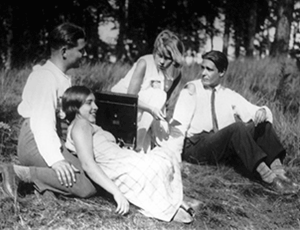
In Flight of the Red Balloon, he floats around 2007 with his camera and his microphone and turns the concrete into the vague and the vague into the concrete. Like People on Sunday, it's a memoir of the present: proof that cinema is greater than poetry. It is only as nostalgic for Albert Lamorisse's film as the present is for the past; an impossible gulf separate the two, and yet the latter is always inescapable, present in the form of places, memories, connotations. In the 21st century, we are always reminded that there has been so much history as now.

The main characters pose for a picture in Exiled (2006; released in the States in 2007)

Fred Camper is braver than most of us. He dared to write about Johnnie To in terms we secretly wanted to use. In the language we wanted to apply: not in misleading Peckinpah and Leone comparisons, but in sacred words reserved for Grandpas Ford and Hawks, for classical cinema.
Exiled is the marriage of To, the pulp dramatist and comedian, and To, the poet of gangs and personal histories. Sympathetic critics compare the film to a late western, but only because westerns and film noir are the only genres to no longer carry a stigma--they've become sacred cannon. Others meekly say the movies is "more than an action flick," as if a work in that genre is incapable of greatness by default--to be good, it has to be similar to something else.
Exiled is certainly an action film, nothing more, and that is more than enough. It's a gun operetta, with choice solos by Anthony Wong's austerely jowled face, one of the most beautiful in modern cinema.
An actioner is as much about shootouts as a western is about horses and Indians or a film noir is about criminals. Most reviewers need new glasses; they mistake a ricocheting bullet for nihilism. Do they still mix up musical numbers with escapism?

A promotional still for Death Proof (2007)

Why is Jackie Brown Quentin Tarantino's most lasting film? Because it's his least ironic. It's the work of a lover, not an expert. Of a friend, not a taxonomist. Most importantly, it's a movie by someone who believes in the exploitation film, not someone trying to sell their knowledge of the genre. Coincidentally, it's one of his least popular and commercially successful projects.
The extended cut of Death Proof, shown abroad and available on DVD in the US, will last, too. It treats the world of genre movies and general business of commercial filmmaking unironically. It emulates rather than imitates. It has a secret ambition: to move beyond Kill Bill's brand of Jack Hill "sexy feminism." Liberation through transgression: Tarantino's sexual fetishes are no longer suggested, but are instead lingered on; the abrupt, violent conclusion doesn't bring closure--it creates possibilities. Death Proof's free women are in the imagination of a free man.

Friday, January 25, 2008

2007 in Review: Two Subtle Leaps

Everyone has already written about their favorites. I've been lazy. I've spent January cleaning the salt off of my shoes; my fingers stink of vinegar. "What was your top ten for the year?" was a December question. It was asked on slow buses and in movie theater lobbies. Everyone agreed it'd been a "good year." Everyone wanted to know your favorites.
There's a difference between speaking and writing about movies. The problem with writing is that movies age differently from essays. Written words always feel like they're a million years old, already so far behind, but at the same time they don't get old quickly like films, which are so much like people--they get wrinkles, gray hair, they start to forget. What once seemed right becomes questionable. Movies are hard to judge, at least with traditional language. They shift in your memory and they tailor themselves to your experiences. What was a bad movie six months ago becomes a good one. The last year's masterpiece crumbles.

Bill Morrison (left) and Ralph Tyler (right) in a still from Peoples House (2007)

I watched Andrew Bujalski's short Peoples House on the little TV set in my living room, sitting with the remote in my hand. Peoples House is only 8 minutes long. It lives in the extras of the DVD of Mutual Appreciation, Bujalski's second feature, just above the commentary and the trailer. It's Bujaski's first work in video, and his first in widescreen.
Aesthetically, Andrew Bujalski is Maurice Pialat's cousin. He is also Pialat's opposite. We see the same techniques in their films, but used for completely different reasons. Pialat's elliptical edits nonchalantly jump across time; he treats a few seconds or a few months the same way. The things that happened in between, the events we didn't see, have been omitted because they didn't matter. Certain events that we experienced seemed important at the time, but they aren't worth a damn in the long run. It can be heartbreaking.
Bujalski's ellipses instead give us an expansiveness. We cut from scene to scene because those are the moments we're focusing on for now, but the film acknowledges that a lot happened in between, or might have happened at the same time as the actions we're watching.
Peoples House is Bujalski's most elliptical film and his most quickly paced. We see moments from a lazy afternoon: Jerry Peoples (Ralph Tyler) shows Walter (filmmaker Bill Morrison) around his house. They talk about a grand piano, Walter takes a piss, Jerry shows him a sculpture in his back yard where hornets nest. It's set in the outside world Mutual Appreciation's gaps suggest: the subjects are supporting characters from that film. They are not the twentysomethings Bujalski's famous for: they're well-off middle-aged men; they talk about retirement, their children, work. Removed from the aesthetics , settings and subjects of Bujalski's other films, the film shows the expansiveness of his vision. It is a leap forward, and, appropriately enough, a subtle one.

Lars von Trier during the production of The Boss of It All (2006; released in the States in 2007)

Lars von Trier is a liar. He's a traveling magician and a trickster. He distracts you this his left hand so you don't notice what his right hand is doing. He tells a cock-and-bull story while he's sliding your silverware into his jacket.
"The Boss of It All is a light movie," he says, and everyone nods along. We believe because it seems to make sense, like he's done all the detective work for us and, after all, he made it, so he must be right. It's a clever ruse: we don't notice that he's made the greatest leap of his career. He's the emperor who's fooled everyone into thinking he's got no clothes. The truth is that The Boss of It All is the first of von Trier's films to be moral instead of moralistic. Automavision is a fraud, but it's a fraud that's greater than the truth of Dogme.

Sunday, July 8, 2007

A Conversation with Usama Alshaibi About Nice Bombs

Usama Alshaibi smiles frequently. Luckily, he’s got a beautiful, toothy grin. The lower half of his face is covered by a black forest of stubble that’s too short to be called a beard but too thick to be called anything else.

If it were any other season, we would call it a Friday evening—but it’s summer, so we say Friday afternoon (the Sun, after all, isn’t setting for a while). Alshaibi’s 2006 documentary Nice Bombs begins its first theatrical runs next week, and I’ve come by the apartment he shares with his wife and frequent collaborator, Kristie Alshaibi, to talk about the movie. I’m early, and one of the Alshaibis’ neighbors lets me up, asking whether I’m here for the party.

After a brief tour and a demonstration of Kristie's Theremin, Usama and I sit down in the living room, which is spacious and neatly kept.


Nice Bombs has had a longer gestation than a lot of your other work.

Oh, yeah absolutely. I mean it’s my trying to branch out beyond dirty basements and underground fests. Nothing against dirty basements and underground fests, but always with this movie I was trying to appeal to a broader audience. I mean, I still make all sorts of films that I know are not gonna have any commercial success or theatrical distribution—but, eventually, they get in other festivals and on compilations. But with Nice Bombs there’s an immediacy I wanted. I wanted to get it out there and I wanted other people to help me out.

Maybe it doesn’t have a longer gestation, maybe there’s a kind of inverse relationship: some of [your short] films were made very quickly but it took them a very long time to…well, they’ll play at festivals for years. With Nice Bombs it took you a long time to make it—you started it in 2004, so it took two years and now it’s getting theatrical distribution a year later.

But, as you know, as film business goes, it’s not unusual in my time frame. It’s pretty normal. I mean, if I were a big production, it would take the same amount of time. What we spent so much time on was post-production. I was really able to do a lot and focus on things in a way I wasn’t able to before. I had access to real studios and engineers and a full ensemble of musicians who were writing music for specific scenes…and that was weird…what was the question?

Well, it was more of a statement. It seems like a lot of…well, for example, King for a Day seems to have come together very quickly.

Well, King for a Day, that musical I was doing kind of quietly until it was out there because I wasn’t sure it was gonna make it.

Going back to Nice Bombs—with Nice Bombs the first time we showed it in Chicago it was a much longer cut, and since then I’ve edited it down to 76 minutes, which, to me, has made it an even more powerful film.

Was this the one that was screened at the Music Box?

Yeah. So, from that period on, I got distribution and now it’s getting a theatrical release…I think also it is technically my first feature. To have this kind of success—for me, it’s great. Some other filmmakers will be like, “Whatever.” But for me, a ten day run at the Pioneer and a release at the Gene Siskel [Film Center] and hopefully more…well, I’ve never gotten that before. I think it’s a testament to the film and everyone who’s worked on it.

Even though I do use my story and myself, I’ve also made it very accessible. People who have always disliked my work, relatives who just don’t go near my stuff, it’s very appealing to them, and I like that. Even my wife’s relatives, who live in the Midwest. Regular folks. Americans from suburban neighborhoods. Republicans watch this and they really dig it, they’re really into it. They get attached to the characters—the people in the movie. So I think that’s something new that I’ve discovered about myself and what I’m capable of. If I just take these risks and put myself out there, and get away from these boundaries, these artificial boundaries that we set for ourselves when we make any form of art, you know?

I think making films oftentimes involves leaping in, leaping into something. We have, I guess, the myth of individuality, but you have to let the world in, not shut it out.

Absolutely. And to me it’s also gotta be exciting. If it scares me, if I’m, like, nervous, if I’m like “I don’t know if I can do this,” that means the project is good. I’m on to something. If it’s like, “Oh, I know this, this is easy, this is already done in my head”—well, why go through the process? I guess I like discovering things.

The documentary element is not necessarily new, because I also approached my narrative work like that. Some of my early shorts had no script, just a very abstract idea. Or I’d be writing as I was shooting. But with this, it was even more abstract. I was able to kind of take all of that and put it into something coherent. But the experience and the film are almost two different things. Experience inspired me to take the camera and do all of this stuff, but my internalized experience and its connection to the film is something I have that makes things exciting and significant for me. So now I’m approaching everything like that. I don’t know what the hell I’m doing. Part of it and part of what I do is a mystery. It’s a dark tunnel I’m walking into and I only have a little light. Stuff might come out…[laughs] Open to the unexpected.

Do you feel like Nice Bombs was a continuation of your work or do think it’s more of an expansion? Because it doesn’t…to an outside observer it seems odd. To someone who has never met you and has only seen your movies, it seems like a strange direction to take.

Well, what was the longest film I did before that? Muhammad and Jane. All about a European-Iraqi character who comes back to the United States. He was just in Iraq and the United States in the movie is preparing to go to war. It’s this fictional aspect to real life, to something that was happening politically in the street. In fact, we shot part of the movie at an Iraq war protest, and, I think it was on my mind.

Ignatius, I always had this idea that I would go back to Iraq before I picked up a camera and started making films. It seemed like a natural progression. I don’t really think I have enough work out there on this scale to say I have any set way of doing things. I like to surprise myself. I don’t feel like I’m locked down in any sort of genre or form of filmmaking.

Well, maybe it’s best not to have a set way of doing things. Maybe it’s best just to approach everything as if you’ve never done it before.

It’s funny that you say that, because my next film, which is called Baghdad, Iowa, sort of takes what I love about documentaries and takes what I like about fiction filmmaking and blends it in this not really noticeable way. Because documentary is also a form of fiction-making. People don’t realize that. You’re still manipulating information to convey something.

Tell me about Baghdad, Iowa.

I started this a while ago, sort of quietly, because I don’t know what I’m doing sometimes until it’s forming. It was really a sort of organic process. It came out of wanting philosophically to explore more of Nice Bombs, but also realizing that I had to end this movie and couldn’t keep going on and expounding for hours. And so Nice Bombs was in a way looking back to the Middle East, to my past there and then returning—completing something. Baghdad, Iowa is my returning here. And I came from Baghdad, Iraq and landed in Iowa, which is the first place I lived in the United States. My father went to school in Iowa City, Iowa. So my impression of the world was very Americanized but also was Iraqi. And the movie is an exploration of that, in a very surreal way.

You said earlier—I think at the very beginning of the interview—that to you Nice Bombs was a film with a broader appeal, a movie that was meant to be shown more theatrically, rather than at small festivals.

I guess I wanted to make something accessible, I wanted to make something that didn’t have…I guess what I’ve saying is that, since my experience is so unique, I didn’t have a very good perspective on it. Because it was so much about my experience, I needed outside eyes. So I got producers and I worked with editors. I even had a test audience. Just to make sense of it. There was stuff that I just assumed people would figure out. I was very careful—you have to keep in mind, Ignatius, that were a lot of Iraqi docs that came out around that time and before mine, very quickly. And I didn’t want to make something that just lasted until the war ended. I wanted to make something specifically about the situation, but also universal. I think that’s what I learned—a certain mythology that applies to everyone, then you’ve created something more powerful than the specifics of a narrative.

Do you think that Nice Bombs is an American film?

I would have to say that [long pause] it is an American film, because it's about a journey that ends in America, and I think that a lot of immigrants have restless blood in their systems and in their families because they’re not content and something, politically or socially, brings them to places like the West, or America. But at the same time, there’s that great pride in heritage—which is very American. Returning to a place and realizing that you don’t belong is an American story. It’s played in a very literal way—because there’s war, it’s very dramatic. I wouldn’t dare to say I’m an “Iraqi” Iraqi. But at the same time, I am from Iraq. Being an Iraqi American is a closer citizenship title. I feel American.

You can make an American film without being an American. There are more great American films than great American filmmakers.

I do like this idea that things can be international and I always strive to make things that can be appreciated on an abstract level: no dialogue just sounds, visuals. I do feel that Nice Bombs has an international appeal, and I want to make more films like that. I do feel that I have an American vibe that comes out in the movie, especially some of my ignorance and stupidity. Being in a place and just…“What the fuck am I doing?” And being very self-indulgent in that approach. That’s the only way I know how to be; I can’t pretend to be this Arab man, because I’m not. I think my cousin in the movie reflects a lot of that in me…
I think there’s a cowboy attitude—an adventurous, risk-taking quality about Americans. A lot of my cousins that live here thought I was nuts. They were the ones that protested the most, telling me I was crazy.

I remember your mother in the film threatening to disown you.

That we actually cut out. We’re gonna put it on the DVD extras.

She still remembers that, and was still mad after I got back. I don’t know if I’ve told you this, but she had a picture of me near her bed, and she set it [motions placing a photograph face down] so that she didn’t have to look at me. What I went through to make this film! [laughs] Everything’s cool now, though.

You talked earlier about the other Iraq films that came out from 2004 to 2006. For me, what separates your movie from them, is that, in documentaries, especially in American documentaries, there’s a tendency to play dumb, to make a movie to “explain” something rather than document it. Iraq is a situation that’s very hard to explain. Instead of having an explanation and using images to back it up, you’re going out and showing us something, and because of that we might draw a conclusion.

In some ways, I’d say it’s your most subversive film, not in the sense that it’s actively trying to subvert us, but that it is subverting us. I’ve seen it, and I’m infected, I’m sick with Nice Bombs, because there are moments in it I’m going to remember any time I think about Iraq for long enough.

Is it because you felt like you were taken there?

It’s little things. The cat with the flies swarming around its face, and then the old man comes and throws it off screen. Or your father playing with his camcorder. It’s little moments like that that make it a much more human film.

It also makes it a more complicated, a more contradictory film. There’s a tendency to streamline statements, to make sure there aren’t any contradictions in them…

You’re tapping into something there, because, yes, on one layer I’m constructing this portrait, but my internal linear narrative is based on something slightly mysterious to me. There’s no logic or rationale. So, when you remember those flies—I reacted the same way when I saw it and shot it, but I had to bring that emotion in, I had to leave it up there for a little bit and make sure that it worked each time. Because I was reacting to something, and I was hoping that others were [as well]—and they were. I don’t know what’s inside of that, and that meaning keeps changing.

Which is, I think, what makes it better, because you’re not something concrete to each moment. It’s an image that’s mysterious, and as an audience, we project something on to it.

I think any time you are watching a film, you start asking, questioning these basic things inside yourself. Like, for example, people who are sympathetic to the cat: does it bother them? Do they ever ask themselves: “Why do I care about this cat? There’s war, there are all these things going on, why do I care?” There’s a dilemma, there’s this draw, this emotional pull. We can’t help it.

I was also very conscious of animals throughout the whole movie.

Well, it’s not the first cat we see…

There’s a monkey, the dogs…[laughs] I guess I was looking for things that reminded me of my childhood but, in the context of war, were really quite alarming. You almost wouldn’t look at it, but, if you understood animals…the way that dog was behaving, with his tail between his legs, you know this dog has been severely beaten. When dogs have been abused, they’re so terrified to be near you.

The only dead people that you see [in the movie] are from when I was shooting the TV screen, on the news.

Otherwise it would just turn into a Frontline documentary. That’s fine. That’s their job and they’re good at it. I couldn’t do that, and, instead of fighting it and spending 20 years on it, I just let go and allowed everything to unfold, almost treating it like I was on vacation…

It feels like it’s assembled from home videos…well, it is assembled from home videos. I mean, you’re shooting it with your family. To me, that’s one of the contradictions of it: there’s a grimness to it, but people are still being very playful. It’s not all gloom and doom.

And that would have been a bad idea. I can show a situation, and I can show a mood that was there, but it’s up to…well, I there were some parts were the music was little melancholy and that was on purpose, but I didn’t want to be too over the top.


There is humor. I have a morbid sense of humor--my cousins, my relatives have it. That, to me, is like coping. What else can you do? What else but crack a joke. It seems like the obvious conclusion.

The name of the movie is a joke itself.

Yeah, my sister got mad. She told me to change the title, until I explained it. I think it’s fine.

I’m really proud of it. If I was assassinated tomorrow, I could say, “At least I made Nice Bombs…and some of these smaller, perverted films…”

Now you’re doing the radio thing…

Vocalo

Is it something you would’ve pursued if you hadn’t made Nice Bombs? Did making Nice Bombs open you up…

Totally. Opportunities, grants, [jokingly] celebrities, V.I…V.I...V.I.Ps…

I was considering going back to my old skill, washing dishes as a prep cook. I’ve done the most disgusting jobs imaginable. Migrant worker, slave labor. So getting work at Chicago Public Radio, being able to go out and make these mini audio documentaries, it’s great. I love it, I’m getting good at it—they don’t have to be these serious things, I can just make profiles…

I like audio. I always used to seek out other professionals that were good at audio, and now I’m getting better at it. It’s like training. I’m digging the job. It keeps me fresh and it makes me more excited about my work and it makes me delve deeper into things.

Monday, March 19, 2007

La Ronde / Private Fears in Public Places: The Theatre

I followed up the EU Fest screening of of Alain Resnais's Private Fears in Public Places with a VHS copy of Max Ophüls's La Ronde. Both films are based on plays, and neither attempts to hide the theatricality inherent--but at the same time the way it's handled and used in the two is radically different.


1. First, Ophüls's film: several vignettes, linked by a narrator who pops in bit parts, costumed, and returns us to the visual metaphor of the merry-go-round (ronde) as a linking set. The stories transition from one another slowly, spending as much time in between as it would take the stage hands to move new set pieces out behind the curtain in a live production. It's an element of the theatre, that live fluidity, that Resnais's film disposes of by linking its stories with a cross-dissolve to falling snow, therefore suggesting a white and icy Paris while managing to show the city itself once--and even that evokes a theatrical trick, some choice lighting and a backdrop.
But here things go in an odd direction: Ophüls, whose film is meant to replicate the feeling of attending a performance, right down to timing, lack the immediacy of seeing something performed. After all, popular theatre (including opera and ballet) derives its power from being immediate--from the fact that the sets are being changed in a room with us, or that the singers or dancers are on an immobile stage, performing for us. Watching someone sing in a movie and seeing them do in real life is not the same thing, and Ophüls circumvents the problem by replacing every theatrical trick with a cinematic one--scenes that rely on the presence of live actors in a play are reinforced by camera movements, long takes that by their very nature seem more impressive than the long take of real life.

2. Resnais, on the other hand, transposes and footnotes. In La Ronde, cinema is substituted for theatre, but in Public Fears in Private Places, theatrical performance is presented in its true form with cinema as a form of commentary. The sets are sets, with some photographed from up above with a transparent ceiling; most are only ever shown from one side, like the bartender's cozy kitchen, framed so as to never show his bed-ridden father yelling from the next room. Even the detail is used theatrically--objects and details are never lingered on (as they would be only specks to a live audience), and on close inspection one realizes that a TV in one of the main sets is not plugged into anything.
For the most part, the film evokes a European television project from the 1960s/1970s in its two-medium-shot set-ups and waist-level camera--it's something that put me off at first, but you have to fight that aesthetic fascism within yourself and see whether it's genuine dislike or simply prejudice. But occasionally a cut or a camera placement radically alters the (theatrical) space, re-describing in ways that can only be done in the aftermath of a live performance. And it's not just the acting that is altered by cinema: by cutting between differently lit versions of the same set, Resnais is able to use lighting both theatrically (as drama) and cinematically (as expression). In one sequence, a warmly lit room becomes a cold and foreboding interior during a minute's worth of difficult conversation; in another, the garish hotel bar, whose purples now seem intertwined with the film in memory, is re-lit with a single spot-light, suddenly showing it as a place no different from any other fashionable bar--not the comforting Technicolor lounge the characters hang around.

Tuesday, February 13, 2007

Andrew Bujalski Interview

As Mutual Appreciation is seeing a DVD release via HVE this month, I'm reposting a brief interview with its director, Andrew Bujalski, I conducted shortly before the film's Chicago premiere in the fall of 2006.

Mutual Appreciation is in black and white. Funny Ha Ha was in color. How is Mutual Appreciation more a black and white film than Funny Ha Ha? Was it something you intended while writing the film?

My quick answer is that I believed Mutual to be a (peculiar) comedy, and that I thought black & white would be funny. I can't remember at what stage in
pre-production I settled on [black & white] but I'm sure Bob Dylan/Don't Look Back had something to do with it; that said my great fear was that people would read it as merely an allusion, a tip of the hat, to all the great cinema in that format, and I didn't mean it as such. The fact that [black & white] is relatively rarely used for narrative features these days doesn't mean that the medium isn't still alive and kicking and packing a punch. It's a great thrill to get [black & white] rushes back from the lab and project them on a wall; contrary to what that one Paul Simon song says, I'd argue that everything looks better in black and white.
We've reached a point where video and video-editing has developed very far--far enough, in fact, that it's a separate medium and a separate approach to the world from film-based editing and shooting. Why have you choosen film?

Because it's still better! I was hanging out with a friend the other night and we turned on the television and stumbled upon a very peculiar episode of The Monkees,
which deviated from the regular sitcom-y format, this one was just a psychedelic documentary of the group on tour--the footage was all gorgeous, the editing was bizarre and gripping (old school avant-garde, there's an oxymoron for you), and whatever technology has come since to replace all that hasn't won my heart the same way.
I've read that Chantal Akerman was your thesis advisor. Has she been an influence on your work?

Chantal was indeed my thesis advisor. I'm hugely fond of her personally, am sure I learned a lot from her directly then, and of course [I] am a fan of her oeuvre as well. That said, as a cinematic forebear I don't think I've taken more (or less) from her than I have from 100 other filmmakers whose work has stuck with me.

Did you make any films before
Funny Ha Ha? Shorts and the like?

Sure—my Chantal-advised thesis was a 26-minute fiction film. Not very good! But an incredible learning experience all around, there's no question I couldn't have made Funny Ha Ha without getting through that one first. Also a handful of other student shorts, both on my own and collaboratively. Some documentary work, which I think has been massively influential on how I approach fiction.

What was the documentary work like?

We learned from the ground up: here's how you load film in the camera, here's how you run the Nagra, here's how the Steenbeck works. Go out and shoot. The observational tradition.

A friend of mine once said that at a certain economic level, every movie becomes a documentary: i.e., with a low enough budget, filmmakers rely on places they actually know and the day jobs of their actors for material. Do you feel that there's a documentary aspect to your films, that in a way you're portraying the lives of people you know in a fictional manner? And is this your primary interest, or, as the friend suggested, a question of economics?

Most good fiction films borrow some energy from documentary, just as the reverse is also true. Which doesn't mean necessarily that I am "fictionalizing" my
friends' lives, on the contrary, I'd more likely say they're "documentarizing" my made-up story. I sort of agree with your friend but think he's looking at it backwards—it takes a lot of money to bleed everything resembling life out of a film.

Monday, February 5, 2007

The Weight of Money

Jens Lekman photographed in Athens, Greece

It's lucky for Jens Lekman that his native Sweden's currency rhymes with Barcelona. The title of "I Don't Know If She's Worth 900 kr," a light pop ditty built around coo-ing girl group backing vocals and a Jens' trademark lazy-electric-rhythm-guitar, is wonderfully casual in its mention of economic realities: the truth is, can Lekman spare the money to visit a girl in Spain? He starts the song by admitting that he falls in love too easily--that the gap of social reality (money) and social fantasy (a love affair) forces him to confront the validity of the latter. It's a natural though process we engage in daily; we greatly underestimate the role economics, or the concept of value in general, plays in the way we analyze our surroundings. We guage how much we liked a film by whether we'd pay to see it again, how much we enjoy the book we're reading by whether we'd buy it, how much we liked the song we heard based on whether we'd buy the CD.
It's the weight of money on our everyday decision making, and its a weight largely absent from the cinema and television of the United States. It's taboo to discuss exact sums in films unless they're unrealistically large heist takes--you're more likely to hear about hundreds of millions in a duffel bag than $67.50 for the electric bill. It's opposite of a noir film, where the world always felt so hopeless because the numbers were so exact. Sitting in the darkened theatre, we wondered whether a person's life was really worth the $200,000 (even after we adjusted it mentally for inflation) in Nightfall, or the few thousand dollars in Thieves' Highway.
Even poverty is a rootless conception, a vague state, the opposite of Chaplin, when we were constantly reminded of hunger, of running away from police and petty stealing just to get a bite to eat; instead, we just have the image of Chaplin, as though the tramp costume is enough for us to understand what it's like to be poor (or, for that matter, rich, as wealth is equally vague in American films). Poor people live in exaggerated squalor now in American films (David Fincher, after all, made decay art design fashionable), but this "hyper-reality" is only connected to social reality by a few choice buzzwords (Welfare, Medicaid), in the same way Casino Royale's James Bond is modernized with the invocation of 9/11.
By denying this social reality, we create a social fantasy that will define the American mindset as well as exact figures would: a desire to portray problems without describing their causes, a post-Left liberalism of gestures that are not as much empty as disconnected. It is the lie that will eventually tell the truth, for cinema has a capacity for history that exceeds that of the written word--a writer, after all, can only write down what he or she knows or notices, but in a movie, there are so many outside factors; an absence is as informative as a presence. We'll go down in history as the Imaginary Generation, using our sense of history to create a pre-historicized present that pretends to exist as a commentator outside of the American (and international) narrative rather than the latest episode of it. Or perhaps that is how every generation has been.

Tuesday, January 30, 2007

What's New?

promotional still for Tears of the Black Tiger

In his most recent entry for the Chicago Reader's often interesting On Film blog, Jonathan Rosenbaum, currently at Rotterdam, takes time in his brief update to muse on applying the "new" label to films, having seen Jia Zhangke's Still Life at its premiere at a festival a year ago, only to find it at Rotterdam this year as a "new film." Rosenabum then divulges that he purchased a DVD of the film, which is available on the Chinese black market (the only way to find many of the director's films in his native country) for 60 cents
.
So is this a new movie or an old one? I'm reminded of when Chantal Akerman's Jeanne Dielman, 23 quai du Commerce, 1080 Bruxelles finally premiered in trendy New York in the 1980s, seven years after it premiered in Europe, and some reviewers were calling it "the new Chantal Akerman film."

So what defines "newness?" The Thai kitsch-western Tears of the Black Tiger, made in 2000 and shown at Cannes in 2001, will be appearing in Chicago and various other cities this year via the Landmark Theatres chain. There has been a seven-year gap between the movie's creation and its release here. Tears of the Black Tiger is a product of 2000, or rather the bastard child of the late-1990s (mainstream) mentality of film history as a set of moods and color schemes to be venerated or subverted and the cheap hyper-stylization of 2000s Asian cinema.
Though Jeanne Dielman could concievably have been the "new Chantal Akerman film" (as L'Intrus was "the new Claire Denis film" around these parts), Tears of the Black Tiger is not the "new Thai action comedy" because it defines a Thailand of the recent past. It is a question of emphasis and analysis--with a mainstream film like Tears, we tend to focus on how it defines its time and place. But is that where our attention should be? Shouldn't we analyze everything equally--shouldn't Jeanne Dielman concievably then have been "the new Belgian film?" Or is a question of national myopia, or possibly familiarity and context?
Newness suggests oldness. But the fractured nature of history renders ideas such as "new" and "old" meaningless. There is, perhaps, only that which is current (immediate) and that which requires context (distant, historical).

Saturday, January 20, 2007

Charles Adare arrives for dinner...


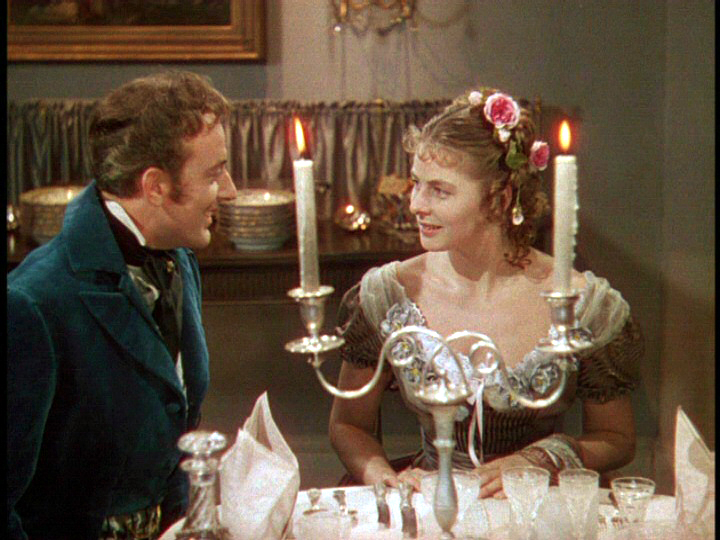
A horse-drawn carriage pulls up—it’s in a studio somewhere, some potted palm trees and a moody backdrop suggesting the Australian countryside, sometime in the evening. The lantern lights the coachman’s face moodily from underneath. There’s a shot of a sign, some dialogue, a zoom into an obvious matte painting—Under Capricorn’s greatest strength is how studio-bound it is, how obviously false. 19th century Australia is created not through location shooting, but through well-appointed room, long hallways with columns and occasional servants, gentlemen standing around in sparsely furnished estates made to look as opulent as possible with limited means. The unconvincing exteriors only add to a sense of Australia as a sort of mock England—by outside the landscape to a few establishing shots and an opening sequence that could be set anywhere, we are introduced to a world of people trying to create a society despite what might exist outside.

For all we know, Australia could be on the Moon--it's not as though Michael Wilding, playing the newly arrived Charles Adare, would ever notice. The matte painting is soon followed by one of the most beautiful of all long takes as we discover Australia with him—and it is not the Outback wilderness that we are seeing, but rather the house, its servants and masters. He sneaks around the garden, peeking in as Joseph Cotton scolds the help before intruding just in time to cover up for his spying. The truth of Australia, or at least the imaginary past Australia we are seeing here, has nothing to do with the potted palm trees and everything to do with the women fighting in the kitchen or the tiny chain of command established in Cotton’s household.

It's Hitchcock's greatest adventure film, and a reminder of what a great magic trick the moving long take is. And like a magic trick, we forget about its power—a magician never seems that exciting, just kids' stuff, until you happen to see one perform and, embarrassingly, you're a bit mesmerized. The roving camera is an astounding tool for evocation when exploring something unknown, or, even better, something you want discovered. Maybe it's more than a trick--it's a real incantation, a spell that can summon up not just a room, but the society the room is intended for in the space of a few lazy minutes.
Alfonso Cuaron's Children of Men is Under Capricorn's direct descendant—but unlike its grandfather, the film's protagonist is no longer exploring, but interacting, living in the world of the film. The exploration is occurring on the part of the eyes and ears of the audience (the cameras and microphones). The very nature of the roving camera allows us to explore the world around him and the sound, like that in the second scene of Heaven's Gate, suggests an entire universe outside the characters not by merely commenting, but by downright interrupting.

Down with the awkwardness of forced introductions! Bits of newspaper, sound bites, and marks on the landscape do the talking, freeing up Clive Owen, Michael Caine, Julianne Moore and the rest of the cast to explore their own (and their characters') interactions with this imaginary future. We understand the cages cartoonishly stuffed with immigrants well enough on their own so that we can instead focus on Owen passing them by without looking; the world wasting away outside the bus Owen and Moore ride on tells us enough by itself—instead, we can explore how uneasily they sit next each other in the dirty seats of the bus's second deck. These scenes eclipse the film’s famous single-take action sequences—these are moments that recall Ernst Lubitsch in their casual ephemeralism; a Lubitsch dark and despairing, though just as reliant on the cult of the material, of the physical, in the conjuring of imaginary (though no longer glamorous) worlds to support the characters.